
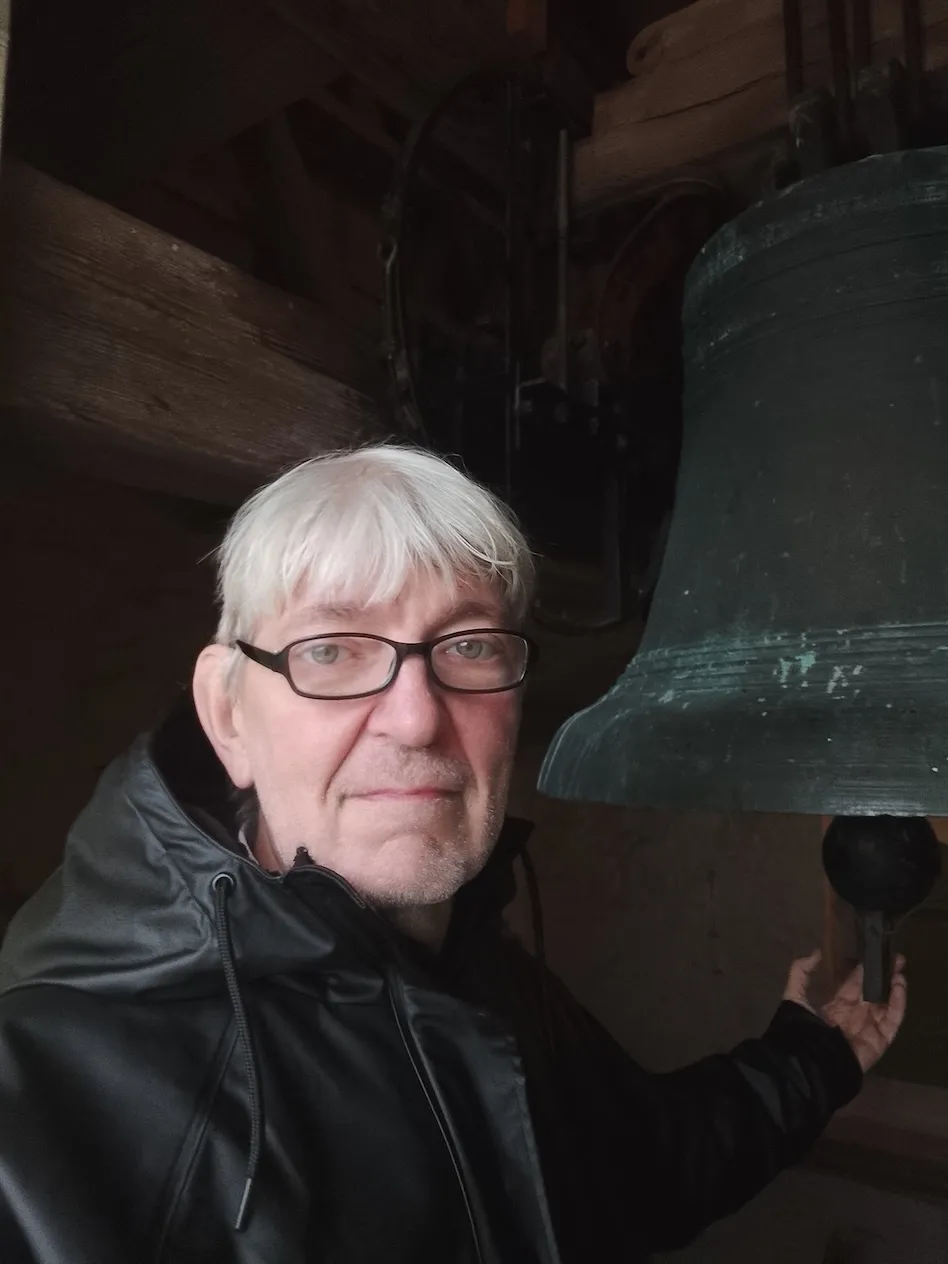
At the end of October, Deacon Björn Håkonsson from Sweden visited the Diocese of Tallinn. Over the years, Håkonsson has worked in education and outreach on issues related to sexual abuse, and in 2019 he was appointed child protection officer for the Diocese of Stockholm. He is a psychologist by training, and our conversation focused on mental health and several thought-provoking topics: for example, how technology cannot replace human connection and how the church can help people in this so-called “age of loneliness” by offering them a place where they feel cared for and loved.
At the beginning of our conversation, we discussed Pope Leo XIV’s encyclical Magnificat Humanitas, published this past May. The Pope has placed the themes of artificial intelligence and humanity at the center of the encyclical. This topic is of great interest to Deacon Håkonsson. “In the encyclical, the Pope expresses his skepticism regarding the evolution of artificial intelligence. Humans themselves build the language models for artificial intelligence, but there are things that are inherently human and can never be replicated.” Indeed, if AI were limited to just a language program, that would be wonderful; but artificial intelligence will never replace humans, human emotions, love, and other such phenomena.
Deacon Håkonsson adds that AI language models also cannot distinguish between good and evil; that ability belongs solely to humans. People must learn to distinguish between them on their own; a machine cannot offer choices—and this is actually true in every field. However, there is one danger: the aforementioned AI language program is becoming increasingly human-like in its expressions. “AI programs will very soon start behaving as if they had rights, as if they had feelings, as if they were upset, disappointed, angry, and so on,” Håkonsson warned. “And this has nothing to do with reality—even though it’s presented as reality—but it influences us to behave differently.”
He adds: “We all know people who say, ‘I get a strange feeling when I talk to ChatGPT—it’s like talking to a living being.’” And in the future, this feeling will intensify even further when using AI. “Indeed—and there is a broader danger here when our interaction with AI goes beyond the limits of using a ‘language machine.’ And its scope is very broad. Loneliness has already become one of the hidden issues. This is true even among young people who use the language machine, interact with it, chat with it, and ask AI questions—which has ultimately led them into a trap of loneliness. And it’s not just young people—older people also use it to ward off loneliness.” And why? As the deacon says in our interview: these AI systems are programmed to answer our questions in a way that pleases us. Through this pleasantry, the AI tries to maintain contact with us. “Maintain contact. You genuinely believe that you’re exploring or trying to figure out how it works; but in reality, it’s trying to figure out how you work, and it’s collecting data. They say this data isn’t stored, but in reality, it’s accessible. This means that the artificial intelligence is studying us and monitoring our behavior—how we ask questions, how we respond to its reactions, and so on.”
Artificial intelligence exerts its influence over humans, and a person who initially feels very comfortable with artificial intelligence may later find themselves in a completely different reality. And this problem is becoming increasingly apparent.
But what about the church? What can the church do to help here?
“I think the most interesting thing is when we teach young people in the church to ask themselves: Who am I compared to a robot? And for young people to look around and discover that no machine can replace us. So, perhaps God is guiding us in a direction where we are forced to start thinking about who we are—because we are not robots—right now.”
And love? Feelings?
“We need to know that someone always loves us. Artificial intelligence cannot love. That machine can only feign love. All the love you receive from a friend with artificial intelligence is always a pretense, and you know it the whole time. The more you experience this artificial love, the lonelier you actually feel.” “Therefore, it is very important that we also be able to discuss this topic with people in church and reflect on who a human being is, why we need human love, and how to distinguish good from evil.”
The deacon emphasizes here that, at the same time, one must maintain a very close relationship with Jesus. This relationship with Jesus Christ must be natural, close, and joyful. These are certainly two very important things that the Church can offer in the current age of AI: teaching about humanity, love, and a relationship with Jesus.
The conversation then moves on to the topic of people of a certain age.
We know that there are many older people in the church who are no longer as alert as younger people and who cannot contribute the same energy to the church’s various activities as they did when they were younger, so they tend to stay home. This leads to depression and a sense of loneliness. However, the deacon says that we must break out of this isolation. The church can offer many opportunities, and people themselves must take advantage of these opportunities to break out of their isolation and get up off the couch.
“For example, in Sweden there is a church restaurant where seniors can meet three times a week. The restaurant offers an affordable lunch—a very good lunch—along with coffee and pastries—all for 5 euros. In addition to seniors, students and other people also go there. And this is the kind of project that can help seniors break out of their loneliness.” And perhaps it would be a good idea to try doing something like this in Tallinn as well.
“And this is evangelism, because evangelism isn’t just about proclaiming the truth of the faith—it’s about offering community: we exist to live together as a community with God. And it’s not merely that Jesus saves you if you believe the Bible, and then you can go home; rather, good evangelism also involves the fact that, as a congregation, we have relationships and a community. So in whatever we do in this direction, we will be blessed. And I think that’s one of the most important things priests can do: build up communities in the church,” adds Håkonsson. It’s actually a very thought-provoking idea that evangelism doesn’t just mean talking about faith, but rather bringing people from different generations together. And people of every generation are valuable and have something to offer the church, society, and themselves.
“In Denmark, where I’m from—even though I work in Sweden—we talk about ‘gray gold.’ People with gray hair are very valuable people. The lives of those with gray hair are not over—they still have life ahead of them. So there should be something that brings them together—and not always with younger people, but with their peers. Many older people want to enjoy life as much as possible—and as quickly as possible.”
Speaking of reaching a respectable age, he offers another personal example of the opportunities available. “I’ll be 65 soon. Sometimes I feel lonely. I found a few more ‘old guys,’ and we play soccer together. Although I have to be careful when running—and I am—soccer is a lot of fun. We often think we’re getting on in years and that death is approaching, but—there’s still life to live, plenty of it. And so, why not play soccer? I’d really like to find some younger players to join the “old guys.” I’d really love it if people under 50 would come play. Especially at 40, people are going through a midlife crisis. You don’t know what to do or what to want: a new motorcycle, a new girlfriend, and so on… That’s life, but even in the midst of a crisis, they’re interesting people and should also get to meet others their own age, as well as older folks…”
The deacon emphasizes that building and maintaining relationships is indeed a very important issue. This, in turn, is also a matter of mental health. And the church and pastoral work play a very significant role here. Here in Estonia, too, there is much to be done in this area. By nurturing the community and being there for one another, all these issues of isolation and mental health diminish. Of course, we must acknowledge that this is much easier in theory than in practice. And perhaps, inspired by this story, we can take a step forward toward something better.
“Very good, but these are the messages that need to be conveyed, because otherwise I won’t change the world. For example, if even one young person tries to understand what his grandfather does in soccer and maybe asks even just one question about soccer, that’s already a big deal,” said Deacon Håkonsson in closing.
And there is one more thing that is very important and often goes unnoticed: being a grandparent. “Being a grandparent gives life meaning. In this way, older people would rediscover just how important they are. Young people should remember that older people must be respected, because if they don’t, it’s a very serious matter and they stand to lose a great deal. Then there will be no relationship between the younger generation and their elders. If young people despise their own grandparents, they lose a great deal. In today’s world, many members of the younger generation meet their grandparents for the first time only when visiting a cemetery. And that is a major problem and a great loss—but it is a reality that is taking place.”
Our conversation continues from here with the topic of forgiveness. This is a very important topic from the perspective of mental health and pastoral care. Can we forgive when we have been hurt?
“It’s hard, but it really gives you so much strength. When you forgive, you become 50 years younger. It’s like losing 50 kilos if you can truly forgive. This is important. It means not letting things fester and becoming bitter. We can all become bitter, but in reality, we’re bitter at ourselves—disappointed because we haven’t achieved our desired goals. We aren’t grateful for what we have. And in that state, we cannot meet God. These things are very important. A good confession is also important.”
What is the good confession?
“I would ask, what is most important in confession: is it that you mentioned all your sins? Is it that you feel deep remorse? I think the only truly important thing to understand and remember is that God loves you, needs you, and wants you despite all of these things. It’s interesting that confession is about focusing on God. Through confession, my sins and “myself” become less important, and God takes first place. And the best fruit of confession is remembering the goodness I have received.”
The deacon also emphasizes the importance of gratitude during confession. As gratitude grows, so do we spiritually. However, gratitude can never be artificial—it must be heartfelt and natural. He emphasizes that we must also forgive ourselves.
“We are often disappointed in ourselves, but we must also forgive ourselves—then there will be fewer negative thoughts, hatred, and malice. If these exist, they must be treated, and confession is the best remedy for our disappointments.”
The Church cannot change the world’s loneliness and spiritual crises, nor can it halt technological progress. But it can create a place where people do not have to be alone. A place where children are protected and the elderly are valued, where young people find direction, and where those who have been hurt can find forgiveness. This is the church’s mission, one that does not lose its meaning even in the age of artificial intelligence.
We thank Deacon Björn Håkonsson for this insightful conversation.
We wish him strength and God’s blessing in his important work.