
This year we have witnessed a special event – Archbishop Eduard Profittlich’s beatification. In the Diocese of Tallinn we continue the path of holiness of the Blessed Eduard Profittlich and hope that one day the Pope will declare him a saint. This journey is a path of prayer, where anyone’s prayer for someone’s needs can become decisive so that the Blessed Eduard Profittlich may one day be counted among all the saints. We invite everyone to pray daily and persistently through the intercession of the Blessed Eduard Profittlich, our first Blessed. He intercedes for us before God. The prayer and novena can be found on the website www.profittlich.eu. We ask you to use these prayers when praying for your own (or others’) needs.
Here, however, is a brief explanation about beatification, miracles and canonization.
Beatification
Beatification is an intermediate stage in the process of declaring someone a saint. With it the Pope proclaims a Servant of God “Blessed”, allowing his public and ecclesiastical veneration (one may ask for his intercession before God, recall him in the liturgy and prayers, follow his example, etc.), which is limited to a certain place (a particular diocese), or to certain groups of the faithful (for example a religious order), or to a certain people, taking into account the apostolate carried out by the Blessed in that region. Sometimes, as was the case with Saint John Paul II, the veneration of a particular Blessed may also be extended to those dioceses that request it.
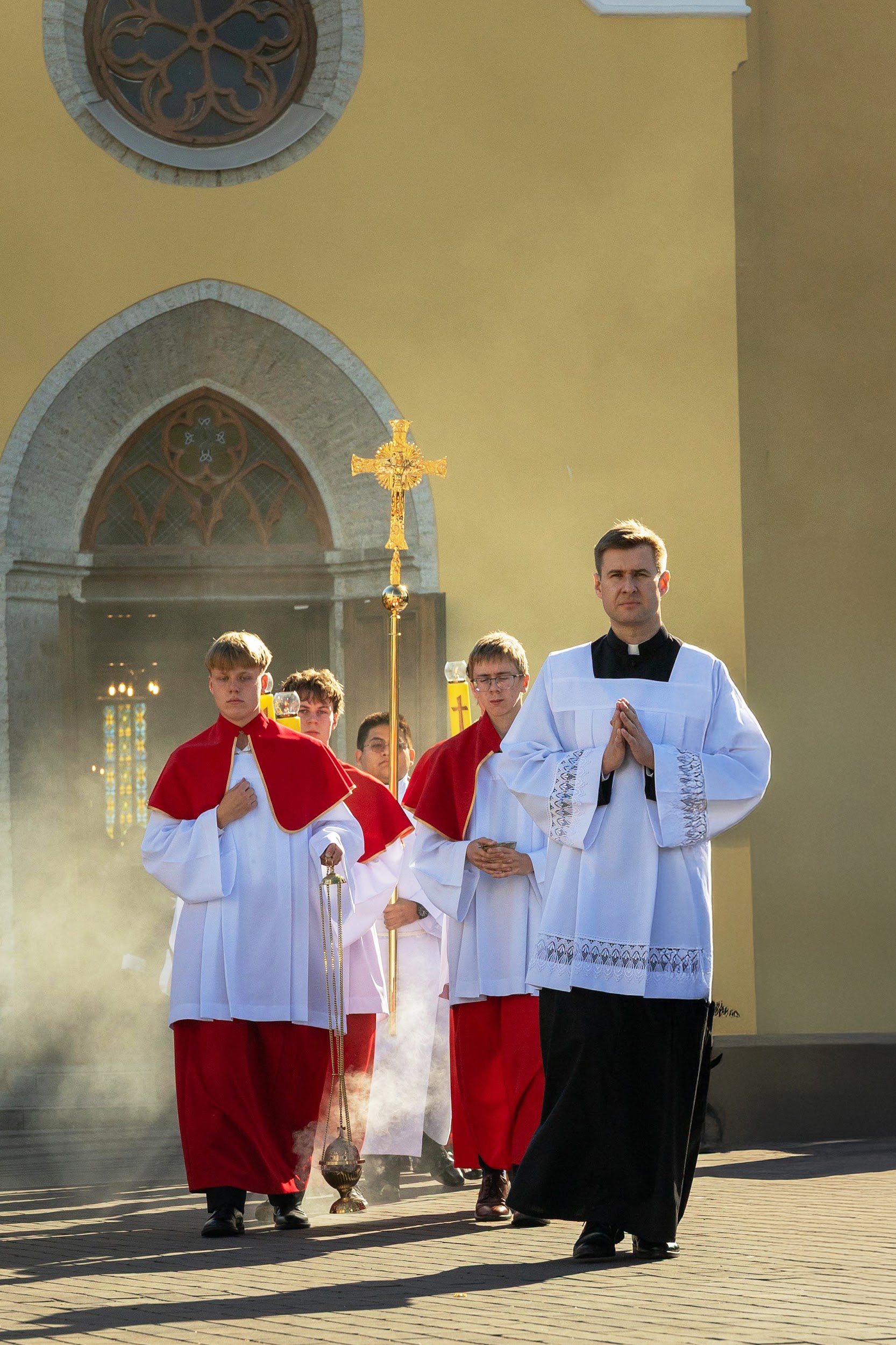
The beatification ceremony takes place during Holy Mass. Immediately after the act of penance, the pope’s representative, who is usually the Prefect of the Dicastery for the Causes of Saints or a cardinal sent by the pope to represent him, reads aloud the apostolic letter signed by the Holy Father. After the postulator publicly presents a brief spiritual profile of the Servant of God, the pope’s representative solemnly proclaims that the Venerable Servant of God may be declared Blessed. Thereafter his memorial is entered in the liturgical calendar, which may be celebrated each year in the places and manner prescribed by law. We witnessed the latter on 6 September 2025 when Cardinal Schönborn, on behalf of the pope, proclaimed Eduard Profittlich Blessed and designated 21 February as the new memorial of the Blessed in the church calendar in the Diocese of Tallinn.
Beatifications always take place in the diocese where the Servant of God lived and died, while canonizations, that is declarations of sainthood, take place in Rome.
After Pope Benedict XVI ordered that beatifications should no longer be celebrated in Rome but should be commemorated in the home dioceses of the Blessed, this function acquired very particular importance. It is indeed preceded by an appropriate local period of preparation in which Catholics, through extensive programmes in parishes and institutions of faith, come to know the life, virtues and effectiveness of the intercession of the Servant of God. In Estonia, Archbishop Profittlich’s beatification programme crossed ecclesial boundaries and had social and cultural impact, involving not only Catholics but also members of other Christian confessions in the beatification programme.
This work of awareness and recognition in the beatification programme is not only to promote admiration for the heroic deeds of the Servant of God and his martyrdom, but also to express his fidelity in following Christ, rekindling in everyone the desire to renew their faith or to turn back to faith. Consequently, every beatification has a deep and very far-reaching meaning. It is an act of love.
Cardinal Amato, who has been prefect of the Dicastery for the Causes of Saints, once said that bishops always see the preparation and celebration of a beatification as an extraordinarily important pastoral event both in the diocese and likewise as a national event, involving different strata of society, because the beatified are treasures of the dioceses and faith communities, whose heavenly presence and powerful intercession before the Lord spiritually enrich each person. Moreover, the faithful feel united in all of this rite, because they belong to their land and culture, and from this perspective beatification becomes a form of religious culture, since the blessed, by their virtuous life in the country and culture where they lived, and which the Church has examined and officially recognized, show that the Gospel of Jesus Christ can be lived consistently, faithfully and steadfastly in every culture and place. Thus we see that there are no cultural prejudices against Christian holiness, because holiness is one and it comes from God, because God is holy.[1] Consequently, the opportunity to celebrate a beatification in a particular diocese is a true blessing that gives a tangible sign of cooperation – not only individual faithful, but all involved parties can cooperate – to make the ceremony day solemn and worthy of God. Thus prepared, beatification becomes an authentic ecclesial experience that endures and remains.
The Church also carries out a great deal of cooperation with various social structures and institutions for the cause of beatification. Why? The answer lies in the figure of the Blessed themselves, who not only foster the spiritual development of the faithful, but by their holy life and love of neighbour cooperate in identifying, alleviating and healing the wounds of poverty, ignorance and exclusion. From a social perspective the Blessed can be described as benefactors of society who contribute to the temporal well-being of others. They also accomplish marvels of harmony between secular and religious authority. They unite rather than divide. As martyrs they teach us to forgive and not to seek revenge, to love our enemies and to pray for our persecutors. The latter is exemplified for all of us by Blessed Eduard Profittlich, regardless of religious affiliation.
All of the above should be continued after beatification, promoting faith and spiritual life daily both in the Church and in society.
Canonization
Canonization, or the declaration of a saint, is the act by which the Pope definitively and solemnly proclaims that a Catholic faithful now shares in eternal heavenly glory, that the saint intercedes for us before the Heavenly Father, and that the whole Church may publicly venerate him.
Blessed Eduard Profittlich died a martyr’s death, and this has been affirmed by the Church. He bore witness to the faith by his life, so no miracle was required for his beatification. However, for full admission among all the saints, into eternal heavenly glory — that is, as a prerequisite for canonization — the occurrence of at least one miracle is required.
Saint Thomas Aquinas said: „True miracles can be accomplished only by divine power: God actually works them for the benefit of people…, to show the holiness of man“ (ST, II/II, 178, 2). The foremost miracle-worker was Jesus, who performed miracles in the forms of healing, resurrection, the multiplication of food, deliverance from torments and dominion over nature. In general it can be said that a miracle is that which nature cannot do: „A miracle is an extraordinary event – caused by God’s special intervention – which surpasses the ordinary course of nature,… to relieve the sufferings of human persons and to show His personal love for them.“ A marvelous event – whether it be a healing or the averting of danger – must be scientifically inexplicable. In addition, it is necessary to verify the temporal and causal connection between the occasion that prompted the miracle and its occurrence.
Canonization is a careful and precise historical, canonical and theological process. In 1983 Pope John Paul II, by the apostolic constitution Divinus Perfectionis Magister, introduced an additional procedural reform which, in cases of miracles, includes the hearing of two official experts, a discussion in the Medical Council at the Holy See, and a theological assessment. With regard to the final stages of the procedure, it should be remembered that after the decision regarding a miracle has been proclaimed and confirmed in the aforementioned commissions, the pope convenes an ordinary consistory, during which he confirms the opinion of the cardinals and bishops and proclaims the date of the forthcoming canonization.
Canonization takes place in Rome, and, presided over solely by the Pope, bestows upon the saint the universal cult of the Church. Canonization also takes place during the Holy Mass and is a solemn and honorable event for the entire Church, because the saints are proclaimers of the word of God and the message of our Lord’s love; they are spiritual magnets who, by their glory, draw the faithful to them, serve as examples, intercede for us before the Heavenly Father, and sustain us with their prayers so that we may bear good fruit here on earth. While beatification has more of a local diocesan dimension and signifies veneration primarily in the region of the Servant of God’s apostolate, canonization has a universal — that is, Church-wide — dimension, content and significance, expressing love for Christ and his saints.
Marge Paas
Source: Angelo Amato (cardinal). Santi e Beati. Come procede la Chiesa. Libreria Editrice Vaticana, 2012.
Read more about who are the Blessed and who are the Saints: All Saints!
[1] A. Amato (cardinal). Santi e Beati. Come procede la Chiesa. Libreria Editrice Vaticana, 2012, 22.