
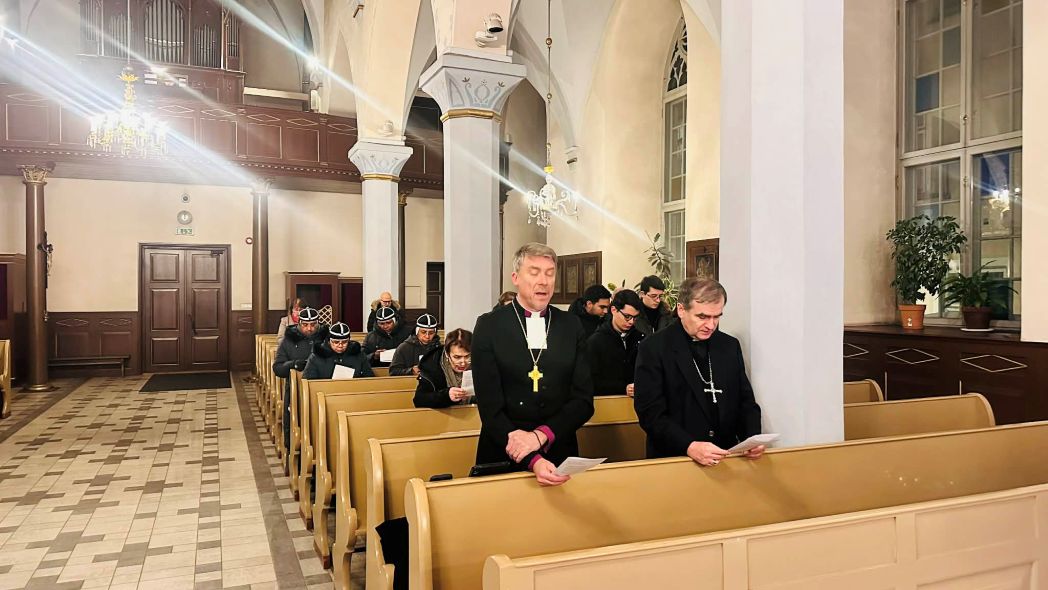
On Thursday, 22 January 2026, a vespers service took place at St. Peter and St. Paul’s Cathedral of Tallinn as part of the Week of Prayer for Christian Unity. Representatives of various Christian denominations were present. The sermon was delivered by Archbishop Urmas Viilma of the EELC.
Here we publish the text of the sermon.
Dear Bishop Philippe!
Dear sisters and brothers in Christ!
I am pleased to participate and preach at today’s vespers here in St. Peter and St. Paul’s Cathedral of Tallinn. During the Week of Prayer for Christian Unity, representatives of different Christian churches around the world, where this week is observed, do not gather to talk about the differences between churches, but to stand together before Christ and listen to what He says to His Church. Not to one or another denomination, but to His Church – the one Body of Christ.
For today’s day of prayer, the accompanying guide proposes as a basis for reflection the words of the Apostle Paul to the congregation in Ephesus. These words sound just as demanding and at the same time as hopeful today as they did two thousand years ago when they were written: “one body and one Spirit, just as you were called to one hope when you were called; one Lord, one faith, one Baptism; one God and Father of all, who is over all and through all and in all. But to each one of us grace has been given as Christ apportioned it.” (Eph 4:5-7)
“one Lord, one faith, one Baptism” – this is not a slogan, it is not a compromise. Nor is it a call to make everything the same. It is a profession of faith – and more than that, it is a call to live in such a way that this confession becomes visible to the world.
We live in a world where there are more divisions than bridges that span them. There are divisions between peoples, in societies, in families—and unfortunately also among Christians. That is precisely why speaking about the unity of Christians and praying for it is not an insignificant side topic, but part of our obedience to Christ. Jesus himself links the unity of the disciples with the faith of the world in his high-priestly prayer: “That they may all be one, just as you, Father, are in me and I in you, that they also may be in us, so that the world may believe that you have sent me..”(Jn 17:21) In this context, the unity of the churches is not an end in itself—unity is a public witness.
When the Apostle Paul speaks of “one Lord,” it means that the Church of Christ does not have multiple starting points, multiple sources and founders, but one. One Lord has laid the foundation of his Church. The Church of Christ does not primarily belong to its tradition, its people, or its history. The Church belongs to Christ. Christ is not divided—his body is not meant to be scattered into fragments. If there are disagreements among us—and there are, unfortunately—then we must never forget that the Lord is greater than any dividing boundary or differing religious understanding on some question.
When the Apostle Paul speaks of “one faith,” it does not mean that we all express our faith with the same words, the same songs, or the same liturgical forms. But it does mean that the source and center of our faith is one and the same—Jesus Christ, the crucified and risen Lord, the Savior and Redeemer of the world. Where Christ is at the center, there is true communion—even if that communion is not yet perfect or is still incomplete.
“One Baptism” reminds us that our Christian identity does not begin with denominational affiliation, but with baptism into Christ. Based on many other characteristics, we define ourselves as Catholics, Orthodox, or Lutherans. In baptism, however, we have all received one and the same calling: to die to sin and to live for God. We are baptized with one baptism in order to enter into communion with the Holy Trinity – the Father, the Son, and the Holy Spirit. And through this, also with one another.
From here opens the connection to Jesus’ missionary command: “Go therefore and make disciples of all nations, baptizing them in the name of the Father and of the Son and of the Holy Spirit, and teaching them to observe all that I have commanded you. And behold, I am with you always, to the end of the age.” (Mt 28:19-20)
Christ does not send his disciples into the world to establish each their own separate competing churches, but he sends his disciples out together. This “go” presumes that no one goes alone. A common mission presumes a common witness. If our message is one, but our mutual relationships say the opposite, the voice of the Gospel becomes quieter. This is the challenge facing the Church of Christ 2000 years after the first Christian Pentecost. Christian unity has meanwhile been lost and has not been regained. This means that we are still on the way, and none of us can say: “I have arrived.” We were sent on the journey together, and we must also arrive together. This being on the way – our common pilgrimage on the path of unity – calls us to humility and patience in love.
Ecumenism must not be only at the level of dialogue, documents, and delegations. True ecumenical unity begins in the heart, in prayer, and in the readiness to see in another Christian not primarily someone of a different belief, but a brother or sister in Christ. Each time we pray together, we take a step closer to that unity which Christ has given us, but which we have not yet been able to receive together from Him.
Here in this cathedral we can already experience what such visible unity could mean. It is a foretaste. We are not yet fully there, but fortunately we are not only at the beginning of the journey toward unity. We are on the way, and we are on this way together. This is the deepest message of the Week of Prayer for Christian Unity. We must pray unceasingly that the Holy Spirit keep us together – in truth, in love, and in a common witness to Christ our Lord, in whom there is salvation and eternal life. Amen.