
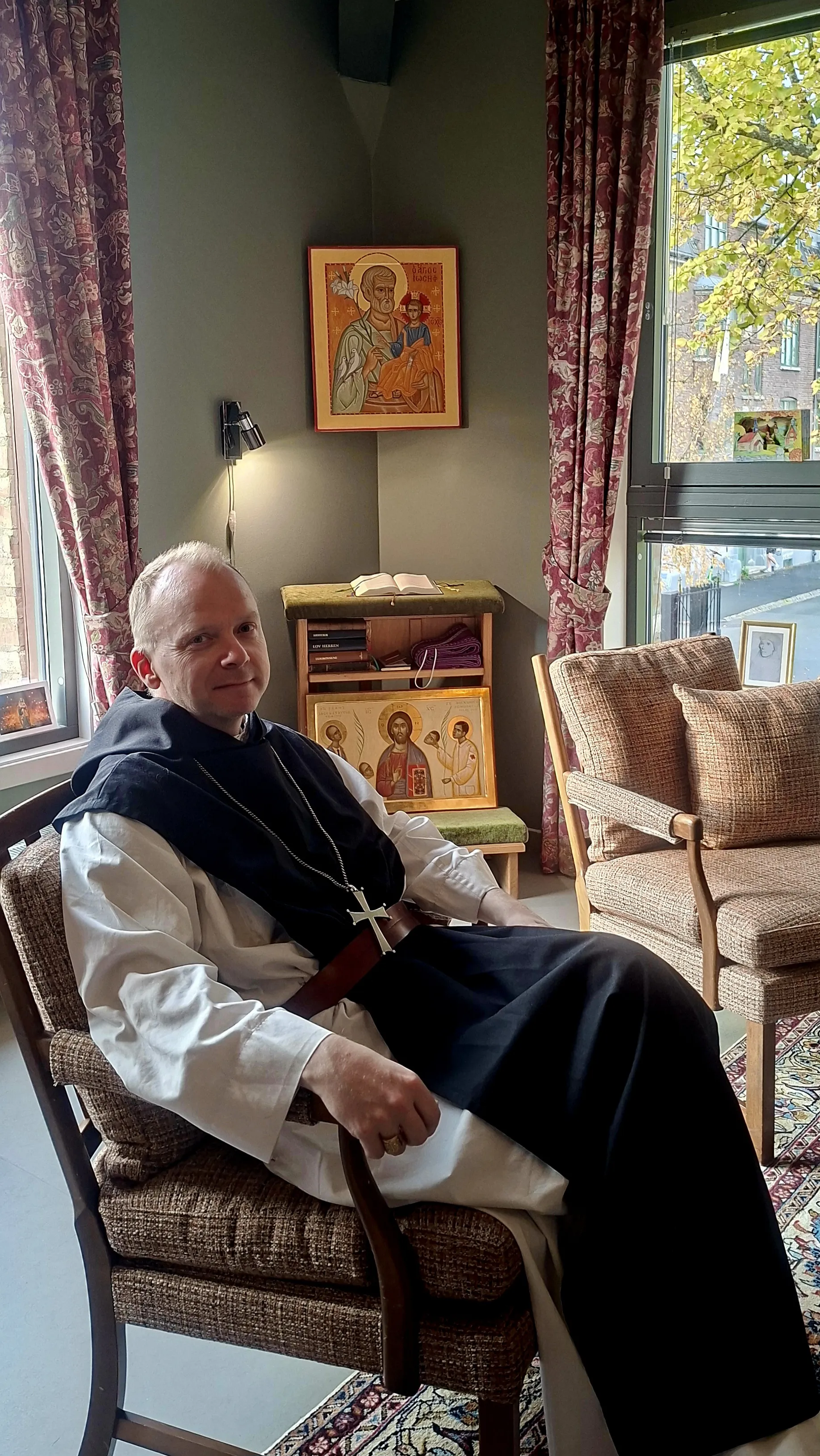
On October 15, I had the opportunity to speak in Norway with bishop Erik Varden, OCSO
Here is a brief summary of this discussion.
Marge: I would like the topic of our brief conversation to be holiness. Yesterday, as I began my presentation, I told the audience that my presentation is actually about holiness. Bishop Erik, I’d like to ask for your opinion—what are the contemporary perspectives on holiness, and how can we talk about holiness and being holy, especially to young people?
Bishop Erik: The most important thing is that our conversation be grounded in Church teaching. The Second Vatican Council emphasizes that every baptized Christian is called to holiness. A Saint is not some special category of people, but rather it means being a Christian who fully embraces their calling and says an unconditional “yes” to God’s grace, His call, and His life-transforming work. Thus, a Saint is a holy woman or man—a Christian who is like Jesus Christ. In fact, we should all aspire to be holy. That is what we are called to do. And God will help us reach that goal, if only we let Him.
Marge: Thinking about the holiness of Blessed Eduard Profittlich, whose canonization is pending and through whose intercession people are called to pray, I would like to ask: why do we actually need Saints to intercede for us?
Bishop Erik: Because we need friends. Human beings were not created to be alone, and God created the universe in time and eternity so that we might help one another attain holiness and fulfill our life’s purpose. This means that together we help one another fulfill our life’s mission and become saints. If I am facing some difficulty, pain, or illness, I can ask, “Please, would you pray for me?”—bearing in mind that this is the prayer bond our Lord has spoken of. You are familiar with the Scripture passage where “… where two or three are gathered together, there am I in the midst of them.” Praying to the Saints is simply an extension of that logic—and a reminder to all of us that the visible Church is one with the invisible Church. … As we affirm before the Sanctus at every Mass.
Marge: And what are your recommendations for people today? How should one pray under the intercession of Blessed Eduard Profittlich?
Bishop Erik: I’m not sure that the words we use in prayer are that important. But what would you do if you had a new friend? Or if you just met someone in line at the movie theater, at the supermarket, or at a meeting, and you had a brief conversation, and you both thought, What an interesting person—I’d like to continue this conversation? …The first thing would be to set a time to have coffee so you could get to know each other better. In the same way, we should build relationships with the saints. The foundation of prayer is always a relationship! First of all, we need to get to know these Saints and give them a chance to get to know us. So, in the case of Blessed Profittlich, we should reflect on his life. We could read some of his letters or shorter writings, analyze the uniqueness of his witness, and then simply talk to him about our concerns and needs and try to see how they overlap. By doing so, you are already praying and need not worry too much about what the words are or should be.
Marge: And my last question… We’ve talked about how the Catholic Church in Norway and the Catholic Church in Estonia are quite similar and growing, we are currently experiencing a so-called “spring of religious spring time”—so what would be your message to Estonian Catholics?
Bishop Erik: Love the Lord and be faithful!
Marge: Thank you!
The conversation with Bishop Erik Varden took place in Trondheim on October 16, 2026,
Marge Paas.