
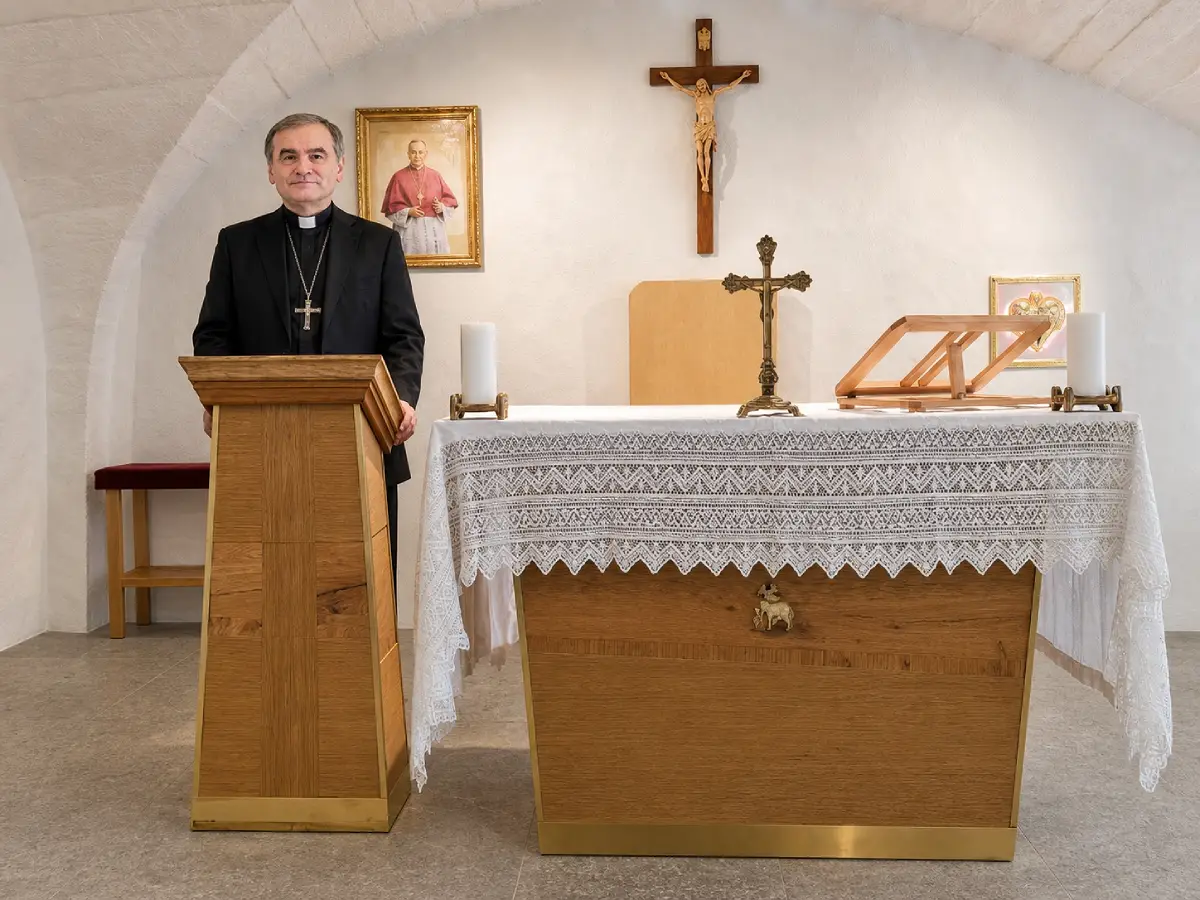
Today I am here with you to talk specifically about Sunday school, which is, I would say, the most precious part of every congregation, because it involves children—our children. As the Church teaches, children are first and foremost entrusted by God to their parents; therefore, parents are the primary educators —the first to bear this responsibility and the ones who also have God’s special grace to help their children in the best possible way. Even if you do not have a thorough theological education, always remember that as parents, you have God’s special grace.
But the Church also tells us that when it comes to the sacraments—Communion and, later, other sacraments such as Confirmation—the Church itself must take responsibility. This is because your children are receiving Christ, and the Church must confirm that they are ready for this and ensure that they are sufficiently well-prepared. Therefore, this preparation is not only the responsibility of the parents but also of the Church. That is precisely why we always say that it is very important for children to receive instruction in Sunday school—that is, in the congregation—and not only within their own families.
Here, things are a bit more complicated for us, because some families live far away and going to church on Sundays is more of a hassle. If we lived in Italy or Poland, where the church is right next door, it would certainly be much easier. It’s a little harder for us, but what the Church says helps: when circumstances are more difficult, God grants even more grace. It’s really worth the effort to make sure the children can attend Sunday school. They’re still at an age where they go only if their parents bring them there. So, while the children are in Sunday school, the parents are almost as much Sunday school students as the children themselves, because they’re the ones driving their children there and so on. But rest assured: if we act this way and if you do everything you can to ensure that the children can attend Sunday school, the results will be good.
On the one hand, they receive Christ in the Eucharist or partake in other sacraments, such as confession. In my experience, children have always been very good at going to confession. We adults, on the other hand, are the complicated ones—confession is harder for us, and that’s why we sometimes put it off. Children, however, are much more sincere and open and aren’t afraid to admit their sins. So going to confession is certainly not traumatic for children; I’d say it’s often harder for adults than for children. Children are very happy to go to confession, they’re joyful about it, and their prayers are very pure.
Then, of course, there’s confirmation. We also need to keep in mind that fellowship is important—this means that the children in our congregation should get to know one another. At this age, we sometimes hear: “My child, who is six or seven years old, doesn’t want to go to church” or “I have a six-year-old who is an atheist.” How did you end up with a six-year-old atheist? It’s a bit complicated, because the child doesn’t even know what it means to be an atheist. Very often, it’s actually the case that if the child’s friends are at church, they’re happy to go; but if they don’t know anyone, everything becomes difficult. That’s why the Church asks us to be together—it helps the children a great deal. When a child sees other children their own age around them who go to church, attend Mass, and receive Holy Communion, everything feels much more natural: they don’t see it as a big deal, they’re no longer an atheist, and they come willingly. This is an important point to keep in mind.
That’s why we have summer camps. I’ve often seen that a single summer camp benefits a child more than a whole year’s worth of Sunday school classes. Not that it replaces them, but by living together with others, praying and playing together, and saying grace before meals, a child actually learns a great deal in just four days. These are very positive experiences that complement the work of Sunday school.
And in this way, step by step and gradually, a child or young person begins to grow as a Catholic and will later bear much fruit. The task of Sunday school is precisely to ensure that all this spiritual and intellectual growth is natural and, at the same time, shared. This means that children grow up together, and this is often the best way for them to grow well and harmoniously.
That is what I wanted to tell you. Since I was born into a Catholic family, I also attended Sunday school from a very young age. I remember that every year in September, two people would visit us. This took place in a small village and was a very important event. One of them was a nun and the other was the director of a sports school—in this case, a rugby school—because that’s mainly what we played there. I don’t need to explain to you that my brothers and I were really looking forward to seeing the head of the sports school, but not so much the nun. It was the opposite for my mom: she was looking forward to seeing the nun, but not so much the head of the sports school. Both came to see if there were any children there who were the right age for Sunday school or the sports school. And of course, we were like all children: we preferred playing sports to going to Sunday school. But my mother always told us that the most important thing was to attend Sunday school properly, and only then did other things come into play. That’s how it went more or less every year, and I’d say that was actually a very wise thing to do. Of course, you can’t expect a child’s first thought or first wish to be to go to Sunday school right away—there are other desires, and that’s normal. Sports may bring a child more joy and enthusiasm than Sunday school, but Sunday school is necessary for them. One doesn’t rule out the other, but priorities must be in place. Then we can be sure that our children are growing up well.
I remember how every year, when the nun from Sunday school came, we would immediately run out into the yard so that no one would see us. But Mom was always there and made the decision. Did she restrict our freedom by doing that? I don’t think so. It’s just that at a certain age, when a child is still young, she chose for us what was more important—even if it wasn’t always what we, as children, found most exciting. But once we started going, as is often the case with children, attending made everything very enjoyable. Sunday school offers many enjoyable things, but it must still be one of our priorities as Christians and Catholics.
Let us strive to ensure that Sunday school truly holds a special place in our hearts, in our families, and in our congregation.