
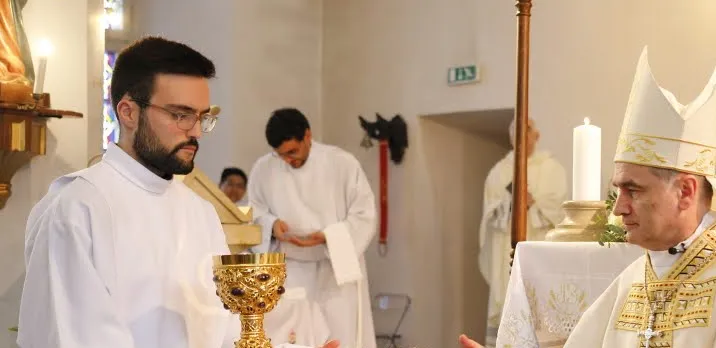
Where are you from? And how did your journey bring you to Estonia?
I’m from southern Spain, specifically from a very small town called Peñarroya Pueblonuevo in the province of Córdoba. The second question is harder to answer. I’ll try to keep it brief. I am the seventh of eight children. Our parents always raised us in the Catholic faith, so God has always been by my side. But it wasn’t always easy. First of all, I wanted to be happy, but where is happiness? I looked for it in my family, but that was difficult because my brothers and sisters were very well-behaved, and I felt like the black sheep; I looked for it in friendship, but I never found joy or love among my friends; I looked for it in the love of a girl, but I was disappointed in that, too. What, then, should I do? At that moment, I heard the Gospel where Jesus said, “The harvest is plentiful, but the workers are few. Ask the Lord of the harvest, then, to send out laborers into his harvest.” That was the moment I felt that God wanted to give me this calling. So I decided to follow Him. At the time, I was part of my Neocatechumenal Way community, and I shared my thoughts with the catechists that I would like to enter a missionary seminary; they then invited me to a meeting in Porto San Giorgio (Italy). Many young people gathered there who were ready to go anywhere; in fact, our destination was chosen this way: our names were placed in one basket and the names of the seminaries in another. Then the name of the seminary was drawn first, followed by the young man’s name. So in my case, it went like this: “Pablo Fernandez Velasco… (silence)… Tallinn. Do you want to go to Estonia?” And then I said something like, “Yes, of course—may it be done as you say.”
Yes, I remember the first time you said you were from Andalusia. It seemed so exotic and sunny right away. But when did you arrive at the seminary in Tallinn?
I arrived in Estonia on September 19, 2018.
Since 2018? So you’ve been in Estonia for quite a while now. What kind of experience has that given you?
I have had many experiences. But in general, I can say that God exists; “where sin abounded, grace abounded all the more.” I say this because I see how weak I am—with language, with learning, and so on. Yet, I have received a hundredfold. I am not worthy of this calling. My experience in Estonia is that God is faithful to me and to everyone.
Do you have a patron saint? Tell us about him.
I really like St. John of Avila, but he isn’t from Avila—that’s just his last name. He is a Doctor of the Church and the patron saint of lay priests in Spain. He lived in the 16th century in Montilla, the town where my mother is from. That’s when I began to study his teachings and pray under his patronage. I can say that he helped me live out my vocation more fully.
*St. John of Avila (Spanish: Juan de Ávila; January 6, 1499 – May 10, 1569) was a priest from Spain. He is best known as the “Apostle of Andalusia,” since his greatest life’s work and his preaching of the Gospel took place in that region of southern Spain. He is a saint and a Doctor of the Church.
What advice do you give to young Catholics in Estonia? How should they live their faith? How can they pray well? Our church is full of young people, and they are finding their way to faith precisely through the Catholic Church.
No one is alone. We are all in the same boat, both priests and other members of the church. The worst mistake is to live one’s faith in isolation. We need moments when we are alone with God, just as Jesus did many times (sometimes he went alone to pray in the mountains), but Jesus always lived together with others. Thank God, there are many different communities within the Church (Opus Dei, the Neocatechumenal Way, the Order of Malta, etc.). For example, we’re starting catechism classes for adults and young people on October 19. Welcome!
Can you tell us a nice story about something that happened to you in Estonia?
I’m not sure which story would be best, because I’ve had so many experiences here in Estonia, both in Tallinn and elsewhere. So I’ll tell you about the most recent story that I liked. It was when I went mushroom hunting with friends, but in the end, I picked a lot of blueberries. In my opinion, that was a very Estonian activity, which helped me blend into the culture. We also found a lot of chanterelles and some boletes.
What advice would you give to a young person who wants to enter the seminary? How would you encourage him to give it a try?
Don’t be afraid. It may seem impossible, but the good news is that God Himself does it. I realized this during my fourth year of seminary. God is faithful, and He doesn’t take anything away from us; instead, He gives us everything we need. So don’t be afraid—give it a try, and talk about it with your friends, family, and spiritual leaders. Don’t hide this treasure, which is meant to save humanity.
It’s probably pretty tough in this society and among the people here, but you’ve likely adjusted. What have been the hardest things here in Estonia? What has felt unfamiliar or more complicated?
Learning the language is the hardest part, but with God’s grace, I think we’ll manage. It’s also hard to get used to the Estonian weather. I come from Spain, where it’s always warm and sunny. But little by little, with God’s help, we’ll manage.
Have you ever met the Pope? If so, what was it like?
Unfortunately, I did not meet him; when the Estonian Catholic Church went to Rome to meet with him, I was in Ivory Coast completing my formation.